
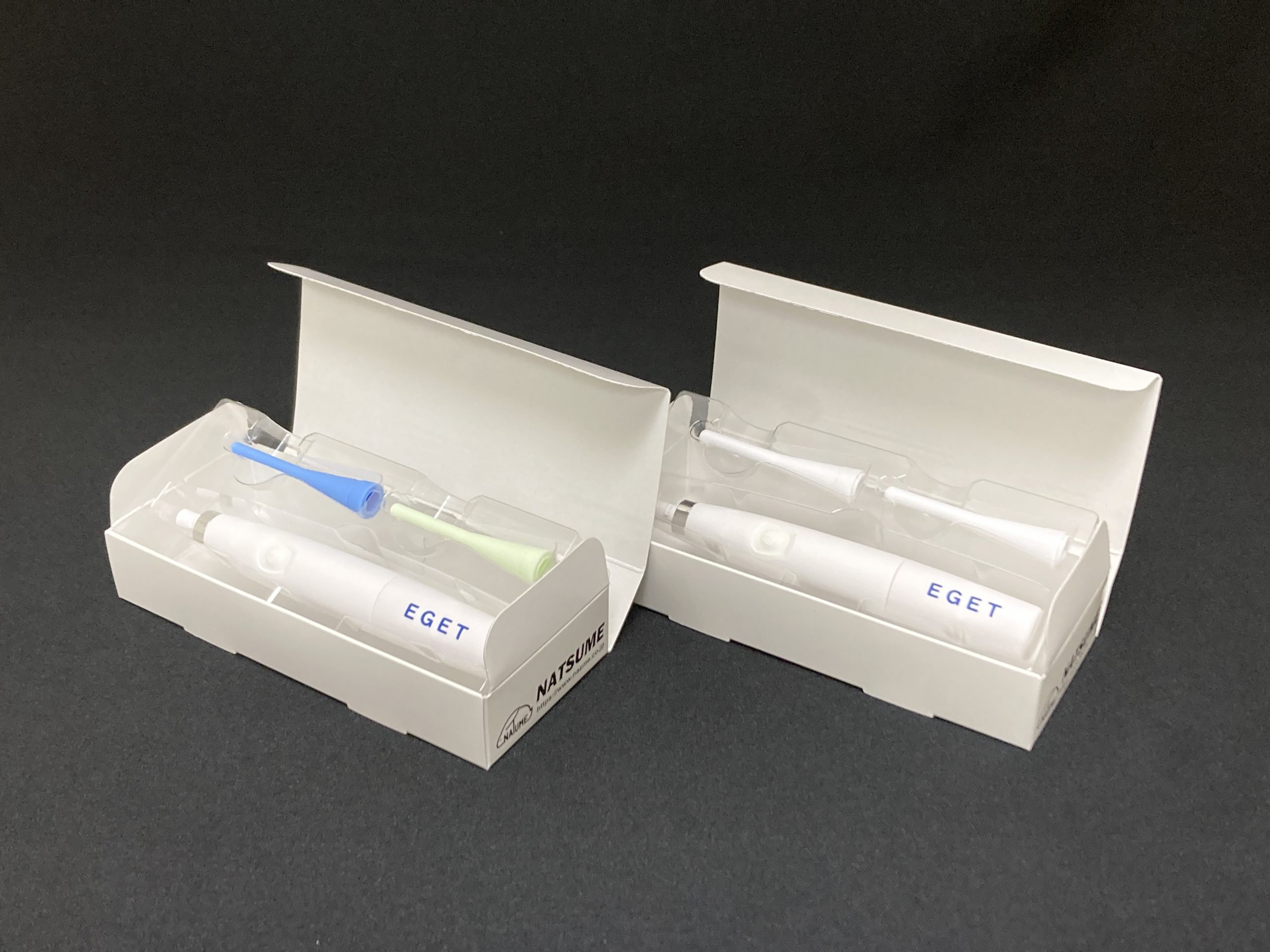
KN-595 EGET

New
EGET click image
Click product pic to get more information

Patent No.7495680
Patent No.7704344
Inventor
・Osaka Metropolitan University (Formerly of Iwate Univ.), Professor Taketo Kaneko
・Institute for Animal Reproduction

EGET stands for
Easy get next Generation by Embryo Transfer

Conventionally, in order to “produce offspring from transplanted fertilized eggs”,
it was required to create pseudopregnant females by vasectomized males.

“Pseudopregnant mouse and rat production device ~EGET~”
does not require a vasectomized male, achieves artificial pseudopregnancy induction.

This method enables the production of spawn from transplanted fertilized eggs in a compact,
and simple operation. It is expected to reduce the number of animals used and the time required.
In addition, pseudopregnant animals can be produced on the day of transplantation.
It can also be used as a backup for conventional methods.
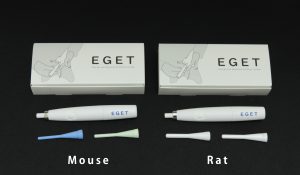
KN-595-35/40 KN-595-50
Target Animal Mouse Rat
Dimention of
Insertion Part
φ3.5mm×L27mm×1ea (Blue)
φ4.0mm×L27mm×1ea (Green)
φ5.0mm×L27mm×2ea(White)
Power Battery-powered (Battery is not replaceable)
One year of use or used for 100 mice
※Assumed number of uses in case of
30sec x 7 times stimulation
One year of use or used 250 rats
※Assumed number of uses in case of
30sec x 3 times stimulation
*Due to the functionality of the product, please use it within the time limit stated above.

*Please comply with local and institutional rules of disposal, or send the entire box of products to us for proper disposal.
*Each EGET is designed to be used 750 times for 30 seconds. The standard stimulation frequency is 30sec x 7 times for mice and 30sec x 3 times for rats.
*The number of times of stimulation is expected to be shortened when the technique is stabilized, so please inquire separately.
*Manufactured and sold by Natsume Seisakusho Co., Ltd. under a patent license agreement.

• Set contents:   1 main unit, 2 tip probes, Instruction manual

*More detailed information on how to use the product is available on the buyers-only page.

■ Information Related to EGET (Reference Literature Included)

*The paper summaries in this section have been machine-translated. Please refer to the original articles below for complete and accurate details.

①Intravaginal Progesterone for Estrous Cycle Synchronization

A new method that transforms mouse breeding. Simply applying a progesterone cream intravaginally synchronizes the estrous cycle with high precision, and combining it with an anti-inhibin antibody increases litter size to 1.6× that of natural mating. Pseudopregnant females can also be produced on schedule without vasectomized males—low-invasive and labor-saving, achieving both reduced animal numbers and greater experimental efficiency.

[Reference]
Sato B, Yamashita Y, Shindo M, et al.
Intravaginal Progesterone Application as an Efficient and Reproducible Tool for Synchronizing the Mouse Estrous Cycle.

Reprod Med Biol. 2026;25(1):e70027. doi:10.1002/rmb2.70027

②Application of Easy-ET to Mice

We extended our sonic-vibration-based pseudopregnancy induction method (Easy-ET), originally developed in rats, to mice, successfully generating genome-edited mice as well. By eliminating the need for vasectomized males, this approach reduces housing space and costs while enabling pseudopregnancy induction, genome editing, and embryo transfer to be completed within a single day.

[Reference]
Wake Y, Endo M, Tsunoda S, et al.
Successful induction of pseudopregnancy using sonic vibration in mice.

Sci Rep. 2023;13(1):3604. Published 2023 Mar 3. doi:10.1038/s41598-023-30774-x

③Shortened Stimulation Protocol for Easy-ET

Pseudopregnancy induction is an essential step for embryo transfer. This study shows that even when the sonic-vibration stimulation of the Easy-ET method is shortened from 7×30 s to just 2×30 s, pseudopregnancy is still successfully induced and normal offspring are obtained. It also enables a same-day protocol—stimulation and embryo transfer performed together on the day of estrus—streamlining workflows such as genome-edited animal production.

[Reference]
Endo M, Tsunoda S, Tawara H, et al.
Successful pseudopregnancy of rats by short period artificial stimulation using sonic vibration.

Sci Rep. 2022;12(1):1187. Published 2022 Jan 24. doi:10.1038/s41598-022-05293-w

④Establishment of Easy-ET Using Sonic Vibration

Easy-ET: a novel method that induces pseudopregnancy in rats using only sonic vibration stimulation—no mating with vasectomised males required—and successfully yields offspring via embryo transfer. By eliminating the need to maintain vasectomised males, it cuts housing space and cost while streamlining strain production and maintenance, including for genome-edited rat lines. A must-know technique for researchers.

[Reference]
Kaneko T, Endo M, Tsunoda S, et al.
Simple induction of pseudopregnancy by artificial stimulation using a sonic vibration in rats.

Sci Rep. 2020;10(1):2729. Published 2020 Feb 17. doi:10.1038/s41598-020-59611-1

【Media and Other Publication Information】

2024.05.01 LABIO21 No.92 (p.20–22) Professor Takehito Kaneko (Japanese)
https://www.nazme.co.jp/images/2023/10/LABIO21_No.92_p.20-22.pdf

2024.05.01 LABIO21 No.92 (p.23–26) Natsume Seisakusho (Japanese)
https://www.nazme.co.jp/images/2023/10/LABIO21_No.92_p.23-26.pdf

2023.10.30 Iwate Univ. (Japanese)
https://www.iwate-u.ac.jp/cat-research/2023/10/005929.html

2023.05.26 Science Japan
https://sj.jst.go.jp/news/202305/n0526-02k.html

2023.03.06 Press Release (Japanese)
https://www.iwate-u.ac.jp/upload/a4c7844421e0e1688b6f3a296b34f044.pdf

■ Request for Information Sharing
If you have relevant knowledge, data, or literature related to this topic, we would greatly appreciate your contribution. With the aim of improving experimental reproducibility and promoting animal welfare, we may review and consider sharing such information on this page.
Contact Us